# Capitalism
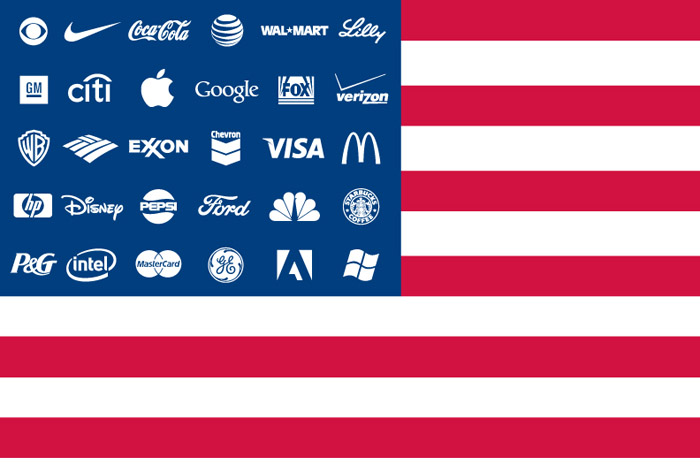
### Gaus, "Idea and Ideal of Capitalism"
1. **Question** Is capitalism is justifiable?
2. **Thesis:** Capitalism consists of private property rights, free market, and hierarchical businesses, all of which are defensible.
3. **Arguments:** You own yourself and can extend your ownership; markets mutally benefit; and hierarchical businesses are
4. **Objections:** You can't own everything; markets do not mutually benefit; tragedy of commons; hierarchy is oppressive.
5. **My View:** Capitalism is ______.
6. **Question:** How do you prevent the tragedy of commons?
### Is capitalism justifiable?
- Many who have taught business ethics in universities are uncomfortable with or opposed to capitalism in its present form.
- Marxists are few in the U.S., but many in academia.
### What is "capitalism"?
Google: "an economic and political system in which a country's trade and industry are controlled by private owners for profit, rather than by the state."
[Merriam-Webster](http://www.merriam-webster.com/dictionary/capitalism): ": a way of organizing an economy so that the things that are used to make and transport products (such as land, oil, factories, ships, etc.) are owned by individual people and companies rather than by the government"
Synonyms: "free enterprise", "private enterprise", "free market"
Capital: wealth; i.e., cash or possibly assets like land and employees.
### Society, Government, Economy
| Government | Economy |
|------------|----------------|
| Democratic | Capitalist |
| Communist | Capitalist |
| Socialist | Capitalist |
### What is capitalism?
MacDonald's owns their stuff. You own your stuff. Starbucks owns their stuff. Keeneland owns their land.
The government "owns" (and manages them for our communal ownership) public parks, the White House, Frankfurt, military equipment, etc.
### Alternatives: Communism
- Communism is the "positive abolition of private property" -- Marx. (75)
### Alternatives: Socialism
> "a political and economic theory of social organization that advocates that the means of production, distribution, and exchange should be owned or regulated by the community as a whole."... "(in Marxist theory) a transitional social state between the overthrow of capitalism and the realization of communism."
### Alternatives
>Like communism, socialism seeks to redistribute the wealth more equitably by the communal ownership of natural resources and major industries, such as banking and public utilities. Socialists also seek to nationalize monopolies, which greatly enrich their owners at the expense of the proletariat. However, unlike communism, most small or nonessential enterprises would remain privately owned. Also unlike the Communists, most socialists do not advocate violence or force to achieve their economic system.[(Citation)](http://thismatter.com/economics/economic-systems.htm)
### What is private property?
* Consumer goods (goods you use, like food, clothes, wifi)
* Capital goods (goods required for producing other goods, i.e., farm equipment)
* Land, Air? Water? Food?
### How Much can you own?
* "Maximally extensive feasible property rights:" Bob gets to use his property free of government coercion, or private theft: use it, exclude others from using it, manage it, receive compensation if damaged, waste it, trade it, sell it, rent it. (75-6)
* In practice, there are limitations on Bob's property rights (zoning laws, historic districts, taxation)
* Anarcho-capitalism wants *no* taxation (77)
### Recap
1. If capitalism is justifiable, then business ethics can get off the ground. Is it perfect, imperfect, or unjustifiable?
2. Property: Maximally extensive property rights
- Can't own everything
- Can own yourself
- Can extend your self-ownership to things
- Agents necessarily own things to be agents
3. Markets:
- Do markets mutually benefit?
- Assymetric bargaining relationship
- Tragedy of commons
## 2. Market Problems
- Mutual benefit?
- Inequality?
- Tragedy of commons?
### Mutual Benefit
- If we voluntarily trade, must one of us lose? (Zero-sum)
- If we voluntarily trade, can we both win (Non-zero-sum)
- 83, "The market is the law of the jungle, the law of nature."
- Pizza and beer
- "Market transactions are built on a foundation of trust" (84)
### Inequality
- The market is not fair
- "Assymetric bargaining power", i.e., extortion and gauging.
- Watering hole example (85)
- A-Z, A'-Z' marriages example -- are Z and Z' free?
- A defense of capitalism shows that the market increases choices overall
### The Tragedy of commons
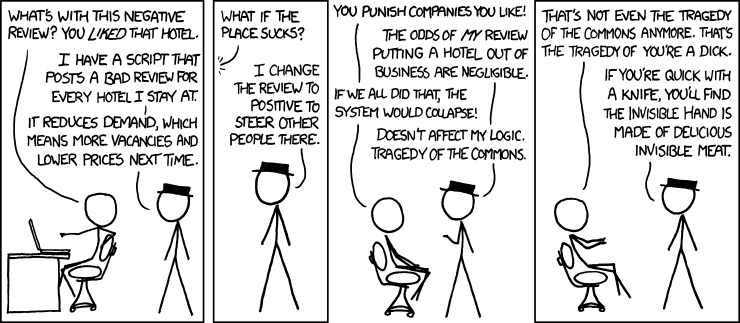
### The Tragedy of commons
>The tragedy of the commons is an economic theory of a situation within a shared-resource system where individual users acting independently according to their own self-interest behave contrary to the common good of all users by depleting that resource through their collective action.
### The Tragedy of commons
- Who should intervene?
- Private conscience, private firm, trade association, non-profit, non-compulsory state body, compulsory state law, or something else
### The Tragedy of commons
>“Nor can certain harmful effects of deforestation, or of some methods of farming, or of the smoke and noise of factories, be confined to the owner of the property in question or to those who are willing to submit to the damage for an agreed compensation. In such instances we must find some substitute for the regulation by the price mechanism.
### The Tragedy of commons
>But the fact that we have to resort to the substitution of direct regulation by authority where the conditions for the proper working of competition cannot be created, does not prove that we should suppress competition where it can be made to function.” (Hayek, 1944)
## 4. Problems with Profitable Business
- Hierarchy efficient but unjust?
- Businesses themselves are socialist micro-societies
- Profit is theft?
### Business as Socialist Society
### Profit
- Scrooge kept all profits too himself
- Yet markets reward those who do not *only* seek profit
- Shareholder owned companies are more complex.
### Before you go
Is capitalism justifiable?
“History suggests only that capitalism is a necessary condition for political freedom. Clearly it is not a sufficient condition.“
—Milton Friedman, Capitalism and Freedom (1962)
“[C]apitalism works better than it sounds, while socialism sounds better than it works.“
—Richard M. Nixon, Beyond Peace (1994)
* Questions?
* Write a short response
* Read for next time
1. If capitalism is justifiable, then business ethics can get off the ground. Is it perfect, imperfect, or unjustifiable?
1. Property: Maximally extensive property rights
- Can't own everything
- Can own yourself
- Can extend your self-ownership to things
- Agents necessarily own things to be agents
2. Market:
- Do markets mutually benefit?
- Assymetric bargaining relationship
- Traedy of commons
3. Businesses: Hierarchical firms for profit
- Group ownership
- Hierarchies are more efficient
- Businesses are little socialist societies; while Society is anarchic